|
|
| Across the United States, Americans are celebrating the 250th anniversary of their nation’s founding. |
| With that milestone in mind, Yale’s Robert Hormats writes in TIME’s Weekend Essay about the ingredient that made the United States so powerful in the first place: immigration. |
| Our special semi-quincentennial issue aims to capture the breadth of this historic moment. We asked 250 influential voices to share something that represents the essence of American life today. Oprah Winfrey selected the Pulitzer Prize-winning book Caste by Isabel Wilkerson. Ron Howard picked All the President’s Men, which he calls a “helluva good watch.” Naturally, Apple’s Tim Cook chose the iPhone. |
| Now, the American experiment enters its next era. The team at TIME will be watching. Will you? |
|
|
|
|
WEEKEND ESSAY
|
America’s greatest strength
|
| By Robert Hormats |
 |
| Photo-Illustration by TIME (Pat Greenhouse—The Boston Globe/Getty Images) |
|
| As the United States celebrates its 250th anniversary, many of us seem to have forgotten a primary reason for America’s great success. In 250 years, our country became the world’s political, economic, and technological leader and the preeminent military, democratic, and moral force. This collective amnesia comes at a time of rising global competition, burgeoning multipolarity, and declining respect for our country in many parts of the world. |
| This competition we face today was on full display during the reception for President Donald Trump's May State Visit to Beijing, China's remarkable infrastructure and architectural achievements televised for the world to see, and broad reporting of China's dramatic technological advances (from human-like robots, to EVs, to solar panels, to widespread use of AI) revived a recurring multi-year debate among international observers and some Americans as well: is America in decline while is China on the rise? Numerous Chinese leaders reinforced this narrative. |
| Yet the narrative may be overstated. While China is certainly on a spectacular rise, that does not necessarily portend America's decline. History is full of two or more countries thriving together at the same time. The 19th-century Concert of Europe saw the United Kingdom, France, Russia, Austria, and Prussia all grow. After WWII, both Germany and Japan rebounded. And in recent decades, countries such as South Korea, Singapore, the UAE, Malaysia, and India have all risen. |
| Robert Hormats is a visiting lecturer at the Yale School of Management and former Undersecretary of State for Economic Growth, Energy, and the Environment. |
| Read the full essay here… |
|
|
|
|
|
|
|
|
|
|
|
|
A MINUTE OF YOUR TIME
|
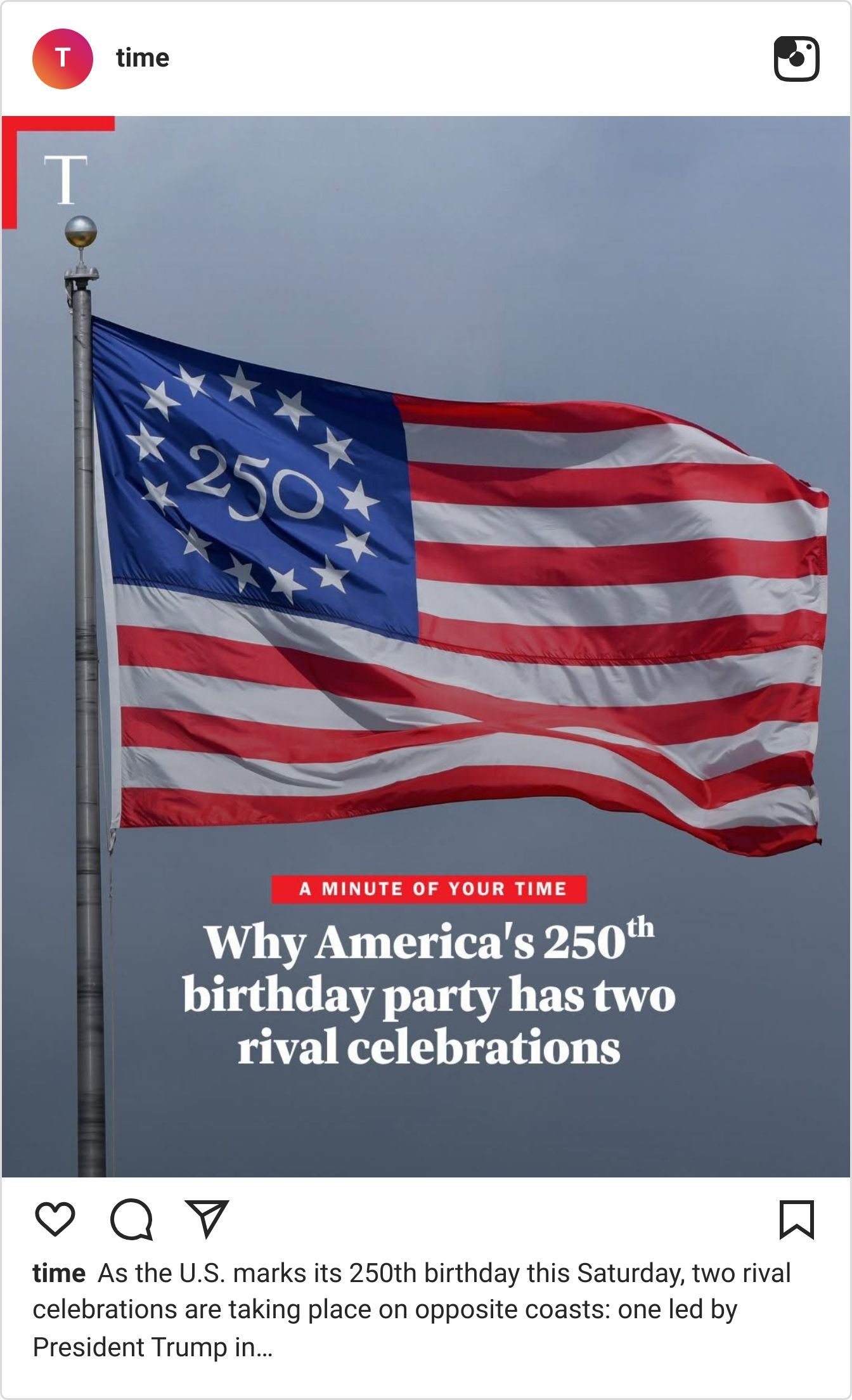
Why America’s 250th birthday party had two rival celebrations
|
| As the U.S. marks its 250th birthday this Saturday, two rival celebrations are taking place on opposite coasts: one led by President Trump in Washington, the other hosted by Queen Latifah in Los Angeles.
The two events are as different tonally as they are geographically. Both are the work of separate federally-aligned groups that are barely acknowledging one another in the run up to the big day.
How exactly did America's 250th birthday end up with two competing parties? We explain it all in less than 60 seconds. |
|
|
|
|
|
|
|
|
|
|
|
|
Linked
|
| In this addictive word-association game, find the steps that will unite two seemingly unrelated words in just four moves. |
|
|
|
|
|
|
|
|
|
|
|
| TIME may receive compensation for some links to products and services in this email. Offers may be subject to change without notice. |
| Connect with TIME: |
|
|
|
|
PRIVACY POLICY |YOUR CALIFORNIA PRIVACY RIGHTS
Questions? Contact thebrief |
|
| © 2026 TIME USA, LLC. All rights reserved. |
TIME Customer Service, P.O. Box 37508
Boone, IA 50037-0508, United States |
| Unsubscribe |
| Terms of Service |
|
|
|
|
|
|