Plus: Graham Platner exits the U.S. Senate race in Maine
|
|
| Hello! Today we’re focusing on why Trump is embracing Syria’s leader despite his ties to al-Qaeda. We’re also looking at Graham Platner’s exit from Maine’s U.S. Senate race and the continued hostilities between the U.S. and Iran. |
|
|
|
Five Must-Reads
|
|
|
|
|
U.S. and Iran Trade Strikes For Second Night In a Row
Iran said it had targeted U.S. assets in Kuwait, Bahrain, and Qatar overnight after U.S. forces struck Iranian assets for a second day in a row. Trump warned the U.S. military response “will get much worse” should Iran attack any more vessels transiting the Strait of Hormuz. —TIME |
|
|
|
|
|
|
|
|
|
|
|
|
|
|
|
|
|
|
|
|
IN FOCUS
|
Why Trump is embracing Syria’s leader
|
| President Donald Trump continues to unravel decades of U.S. foreign policy on Syria after announcing Wednesday that he would remove the Middle East nation from Washington’s list of state sponsors of terrorism, attributing the shift to one person having “done a great job”—Syria’s interim President Ahmed Al-Sharaa. |
| It’s high praise for someone who used to have a $10 million bounty on his head for leading what was formerly a Syria-based affiliate of terror group al-Qaeda, and for someone whom Trump first met just last year. On the sidelines of his NATO trip, Trump extolled al-Sharaa for “stabilizing” Syria “in a short period of time,” branding him as a "strong person" who is "respected by everybody.” |
| But Trump’s diplomacy is notoriously transactional, and his compliments, like the lifting of sanctions on Syria and his apparent validation of the Syrian leader, come at a cost—or at least an expected return. |
| Amin Saikal, an emeritus professor of Middle Eastern, Central Asian and Islamic Studies at the Australian National University, tells TIME embracing a supposedly “reformed” al-Sharaa is part of the Trump Administration’s “regional strategic calculation,” which has also included embracing other controversial leaders including Türkiye’s Recep Tayyip Erdoğan (who has eroded the country’s democracy in his two-decade rule)and Saudi Arabia’s Crown Prince Mohammed bin Salman (determined by the CIA to have ordered the killing of journalist Jamal Khashoggi in 2018). |
| Trump’s already floated his desire for Syria to lead the fight against the Lebanon-based Islamic militant group Hezbollah instead of Israel, whose approach has complicated Trump’s approach to Iran. Trump has claimed that Damascus would “do a better job” at reining in Hezbollah by capitalizing on historical fears from within Beirut. |
 |
| U.S. President Donald Trump meets with Syrian President Ahmed al-Sharaa at the White House in Washington, D.C., on Nov. 10, 2025. SYRIAN PRESIDENCY/ANADOLU/GETTY IMAGES |
|
| For decades, Syria has dominated the foreign policy of its neighbor, having intervened militarily in Lebanon’s 1975-1990 civil war and exerted varying levels of influence and occupation since. Hezbollah also fought alongside toppled leader Bashar al-Assad in the Syrian civil war, stoking concerns in Lebanon that al-Sharaa’s rule could bring renewed cross-border attacks. |
| Under al-Sharaa, Syria has already taken serious steps to eliminate its role as a transit hub for Iranian weapons and money. This has painted al-Sharaa as also highly capable of preventing an Islamic State resurgence, says Ghada Soliman, research fellow at the S. Rajaratnam School of International Studies. |
| The Trump Administration has thus seemingly decided to look past al-Sharaa’s previous terrorist affiliations and judge him instead by his recent behavior and potential. The focus for the U.S., says Neil Quilliam, an associate fellow at the Chatham House’s Middle East and North Africa Programme, is “stability, counterterrorism cooperation, and limiting Iranian influence.” |
| Al-Sharaa, however, may not give Trump everything he wants in return. It might not be in Syria’s best interests to be involved in the conflict, especially as the nation has only begun rebuilding its armed forces that have long been used to fracture the country. “We are looking for economic channels between Lebanon and Syria,” al-Sharaa said last month, “not military ones.” But although al-Sharaa has refused to intervene for now, Soliman says, “U.S. pressure may lead him to change his mind.” |
|
|
|
|
|
|
ONE NUMBER
|
$3.47
|
| The White House on Tuesday announced the launch of “Freedom Fuel” gas stations that sell gas at $3.47 per gallon, a discount from the national average gas price of $3.84 per gallon. Twenty-five “Freedom Fuel” stations launched across the greater Philadelphia area, with a promotional video by the White House showing one customer say, “Thanks, Trump, for saving me some money.” |
| The campaign comes as Trump and the Republican Party have tried to counter Democratic messaging around affordability ahead of the midterm elections, given rising gas prices and overall inflation related to the ongoing war with Iran. |
SOURCE: WHITE HOUSE
|
|
|
|
|
|
|
|
|
A VIRAL MOMENT
|
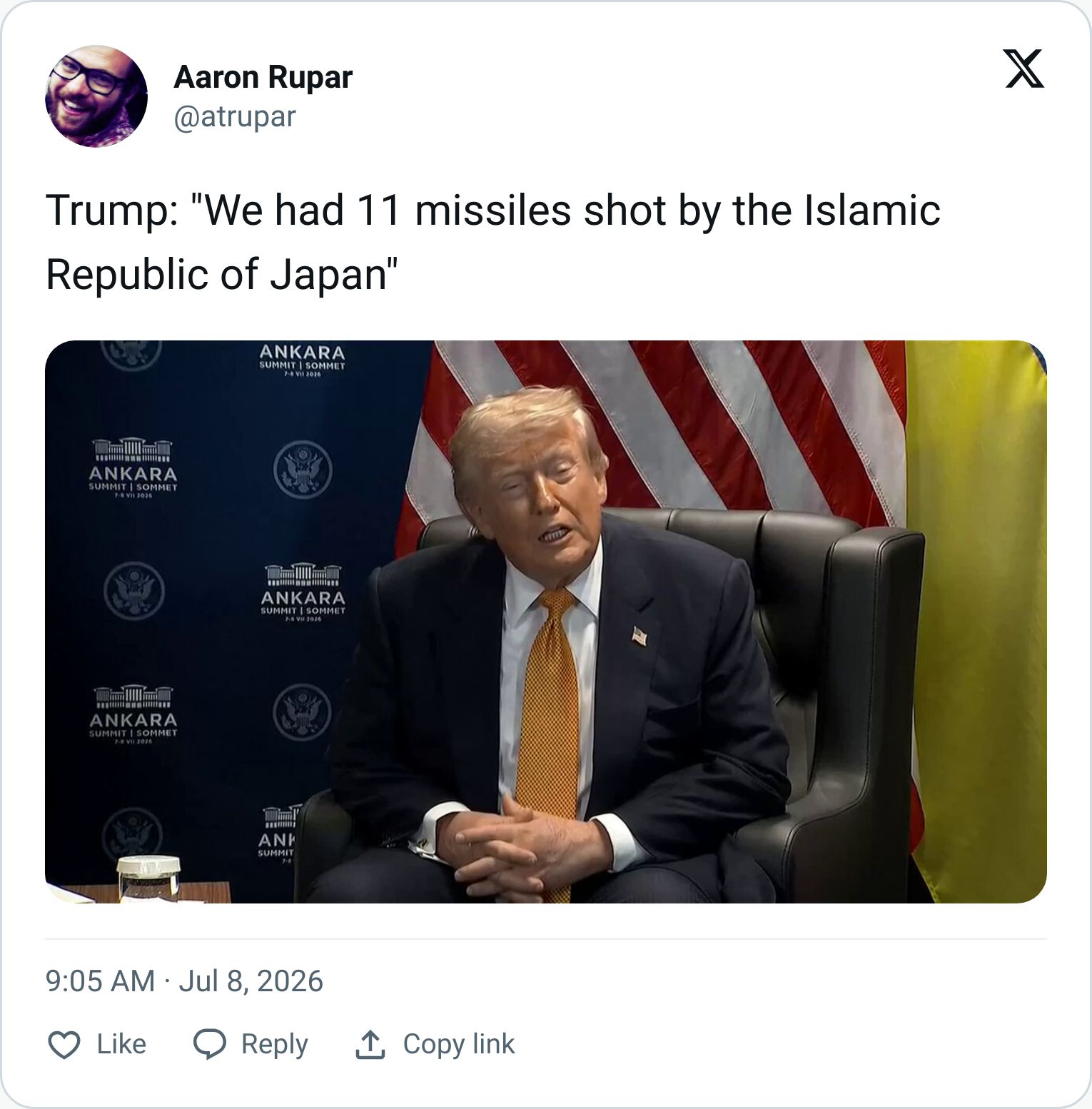
‘The Islamic Republic of Japan’
|
| U.S. President Donald Trump made a viral verbal gaffe on the sidelines of the NATO summit Wednesday, when he seemed to have mixed up a longstanding Washington ally with an adversary. “We had 111 missiles shot by the Islamic Republic of Japan,” Trump said during a meeting with Ukraine President Volodymyr Zelensky—even though he likely meant to refer to Iran. |
|
|
|
|
|
|
|
|
|
|
Linked
|
| In this addictive word-association game, find the steps that will unite two seemingly unrelated words in just four moves. |
|
|
|
|
|
|
|
|
|
|
|
|
|
|
|
|
|
|
|
|
|
| TIME may receive compensation for some links to products and services in this email. Offers may be subject to change without notice. |
| Connect with TIME: |
|
|
|
|
|
|
|
| © 2026 TIME USA, LLC. All rights reserved. |
TIME Customer Service, P.O. Box 37508
Boone, IA 50037-0508, United States |
| Unsubscribe |
| Terms of Service |
|
|
|
|
|
|